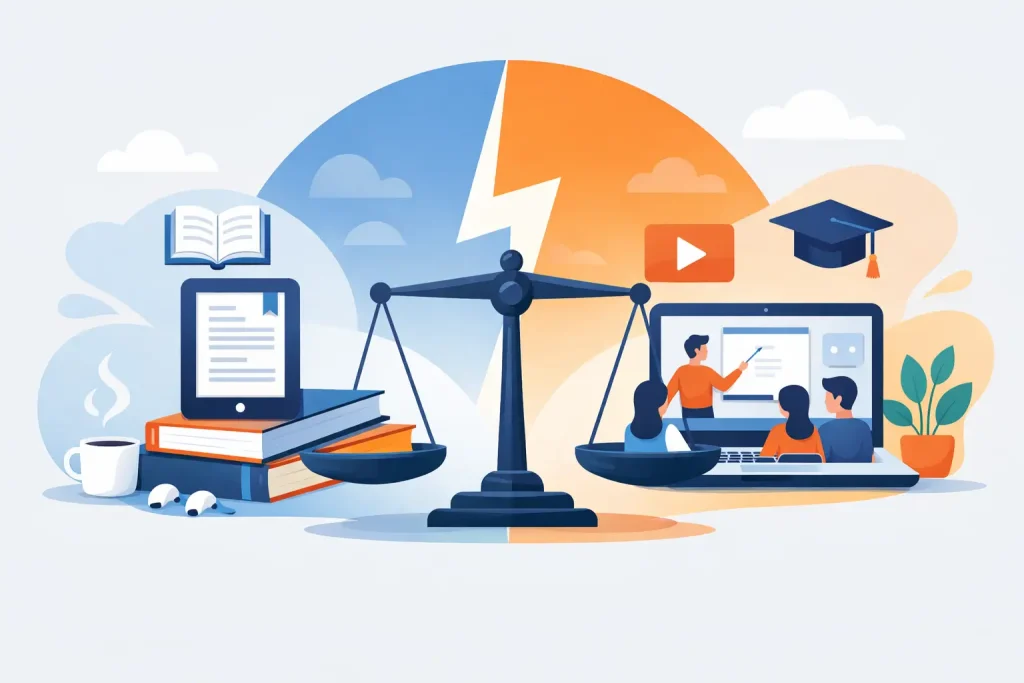
You do not need another $497 promise sitting in your inbox. When people compare ebooks vs online courses, the real question is usually simpler: what will help you learn something useful fast, without wasting money or momentum?
For ambitious readers, side hustlers, freelancers, and early-stage founders, that question matters. Time is tight. Budgets are real. And the gap between “I want to learn this” and “I actually used it” is where most purchases go bad. Both formats can be valuable, but they solve different problems. If you know what you need, the choice gets much easier.
Ebooks vs online courses: the core difference
An ebook is usually the fastest path from curiosity to content. You buy it, download it, search it, skim it, highlight it, and pull out the sections you need. It is self-paced in the truest sense because you decide how deep to go and how quickly to move.
An online course is more guided. Instead of handing you information in a flexible format, it often walks you through a sequence. That structure can be helpful when the topic is complex or when you know you need hand-holding to stay on track.
The trade-off is straightforward. Ebooks give you speed, affordability, and control. Courses give you structure, presentation, and sometimes a more curated path. Neither is automatically better. The right format depends on the type of learner you are, the skill you want, and how much friction you can tolerate.
Cost changes the decision more than people admit
Let’s be honest: price shapes learning choices. A lot. And this is where ebooks have a major edge.
A single online course can cost anywhere from modest to painful, especially in business, marketing, productivity, or AI. Even lower-priced courses can feel expensive if you are not sure the content will match your level or solve your problem. That creates hesitation before you even begin.
Ebooks are a lower-risk purchase. You can build knowledge one topic at a time without making a big financial commitment. That matters if you are experimenting, exploring a new skill, or trying to solve a very specific problem like writing better sales copy, managing your time, improving your mindset, or understanding a marketing tactic.
Affordable learning also changes your behavior. When a resource is accessible, you are more likely to test ideas, compare viewpoints, and keep learning consistently. Instead of betting everything on one premium course, you can assemble your own digital library around your goals.
For cost-conscious learners, that is not just a nice bonus. It is often the reason progress becomes sustainable.
When ebooks are the better buy
Ebooks shine when you want fast answers, flexible learning, and practical information you can revisit. If your goal is to improve a skill without sitting through modules, introductions, and long video lessons, ebooks are often the smarter choice.
They are especially strong for topics that reward reference-style learning. Think productivity systems, entrepreneurship basics, personal finance habits, business ideas, marketing principles, mindset shifts, and AI use cases. In those areas, readers often want a mix of overview and actionable takeaways rather than a classroom experience.
Ebooks also work well for self-starters. If you are the kind of person who likes to search for one chapter, grab the key idea, and apply it the same day, an ebook fits your style. You are not forced to consume content in a fixed order. You can go straight to the part that solves today’s problem.
Another advantage is speed. Reading is often faster than watching. A 200-page ebook may contain the same core insight as hours of video, but in a format you can skim, annotate, and revisit in minutes.
For busy people, that efficiency is a real advantage, not a minor detail.
When online courses make more sense
Online courses earn their value when sequence matters. If the subject is technical, layered, or easy to misunderstand, guided instruction can save time. Some learners benefit from seeing a process demonstrated step by step, especially if the topic involves software workflows, implementation tasks, or a skill where mistakes build on each other.
Courses can also help people who struggle with self-direction. A set curriculum, recorded lessons, worksheets, and milestones can create momentum. If you know you tend to buy resources and never finish them, a course may give you enough structure to stay engaged.
There is also a presentation factor. Some people simply absorb better by watching and listening. If reading feels like work after a long day, video content may feel easier to complete.
That said, courses are not automatically more complete. Plenty of them are padded, repetitive, or built around marketing rather than substance. A polished dashboard does not guarantee better teaching. Sometimes the extra production creates the illusion of depth while delivering less usable content than a concise ebook.
Ebooks vs online courses for different goals
The fastest way to choose is to match the format to the outcome you want.
If you are trying to understand a topic, generate ideas, sharpen your thinking, or pick up practical strategies, ebooks usually win. They are excellent for broad learning and focused problem-solving. You can read across multiple authors and build a fuller picture without spending a fortune.
If you are trying to follow a process from start to finish, courses may have the edge. A structured learning path can be useful when there is a clear sequence, such as setting up a tool, learning a platform, or following a framework in order.
If your goal is exploration, ebooks are usually better. If your goal is execution with guidance, a course may justify the higher cost.
This is why the best learners rarely think in absolutes. They ask a sharper question: do I need information, or do I need instruction?
Completion rates are not as simple as they look
People often assume courses lead to better completion because they are more organized. Sometimes that is true. Sometimes the opposite happens.
Courses can feel heavier than expected. Logging in, keeping up with modules, and finding time for long videos can become a chore. Many buyers get excited at checkout and then stall out somewhere around lesson three.
Ebooks, on the other hand, are easy to start and easy to return to. You can read ten pages on a lunch break, revisit one chapter before a meeting, or search for one answer without committing to a full session. That flexibility often leads to more actual use, even if the reading happens in smaller chunks.
The key is not which format looks more educational. It is which one fits your real life. A resource you use beats a resource that impresses you.
Why affordable ebooks are a strong first move
If you are unsure where to begin, ebooks are usually the most practical entry point. They let you test topics cheaply, learn quickly, and avoid overcommitting before you know what you actually need.
That is especially valuable in fields where trends move fast. Business tactics change. Marketing platforms evolve. AI tools shift constantly. Spending heavily before you have basic context can backfire. A low-cost ebook helps you get oriented first, so your next decision is smarter.
It also helps reduce overwhelm. Instead of searching endlessly for the perfect resource, you can grab a useful book, start learning immediately, and build momentum. That matters more than people think. Progress often comes from starting, not from researching the perfect starting point.
For readers who want practical knowledge without premium-course pricing, a low-cost digital library can be one of the smartest investments available. Daily Dollar Books fits naturally into that approach by making it easy to pick up actionable reads across business, productivity, personal development, marketing, finance, and more without turning learning into a major expense.
The smartest answer is often both
This is the part many comparisons miss. Ebooks vs online courses is not always a winner-take-all choice.
A lot of learners do best when they start with an ebook and move to a course only if needed. The ebook gives them the landscape, vocabulary, and key ideas. Then, if they need a more guided walkthrough, they can choose a course with better judgment and lower risk.
That sequence is often more efficient than jumping straight into an expensive program. It helps you ask better questions, spot fluff faster, and avoid buying structure when information was all you needed.
There are cases where the reverse works too. Someone may take a course for implementation, then use ebooks to deepen their understanding, explore adjacent topics, or continue learning at a lower cost. The formats can complement each other well.
Still, if you are choosing your first move, affordability and flexibility make ebooks hard to beat.
So which should you choose?
Choose an ebook when you want quick access, lower cost, more control, and practical knowledge you can use right away. Choose an online course when you need a guided sequence, visual instruction, or stronger accountability.
If your budget is limited, your schedule is packed, or you are still figuring out what you need, ebooks are usually the better starting point. They remove friction, reduce risk, and make continuous learning a lot more realistic.
The best learning format is the one you will actually open, use, and turn into action. Start there, keep it affordable, and let your next step come from progress rather than pressure.